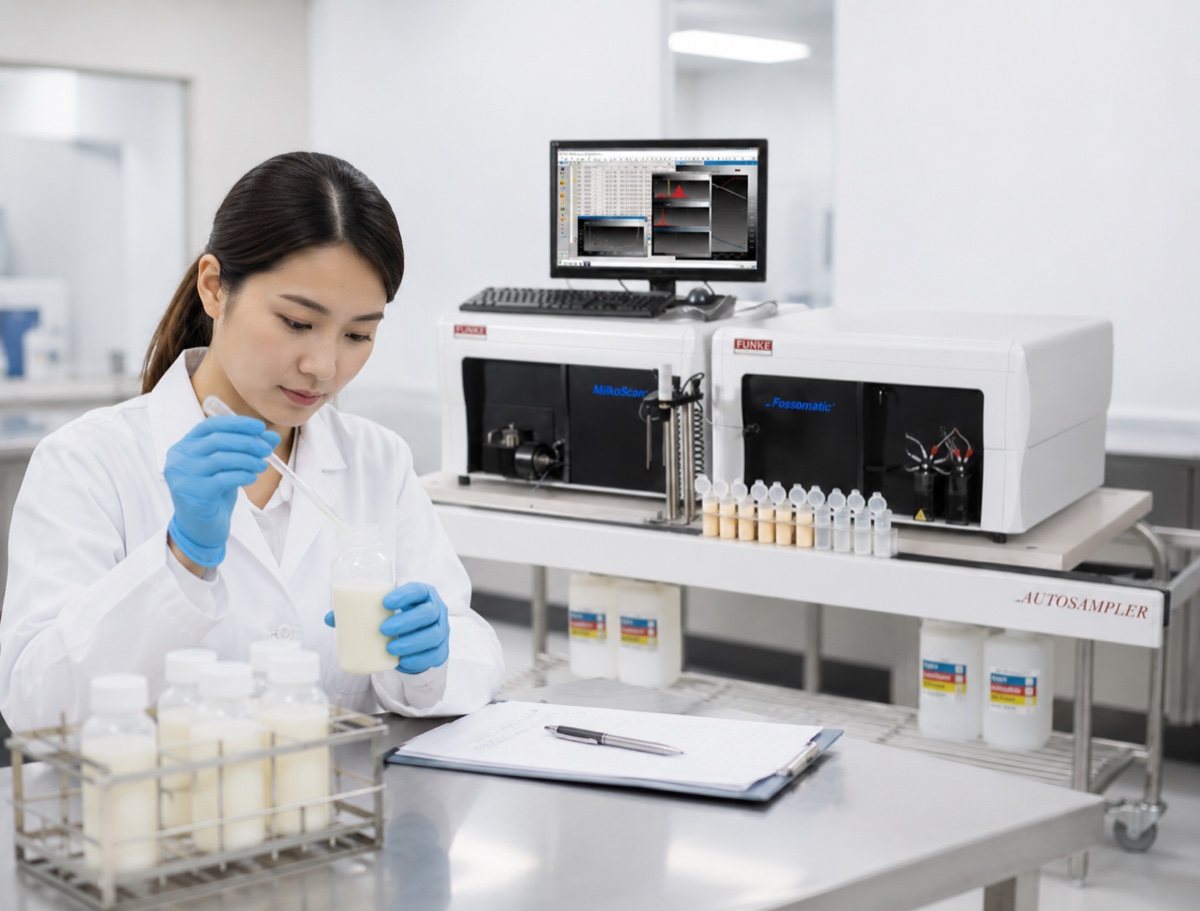
Every time raw milk arrives at an intake point, two sets of numbers have to come out of the same sample. The first is composition — fat and protein above all, because they set the price paid. The second is somatic cell count, which says whether the cow has an inflamed udder. Same bottle, but two completely different measuring principles.
Protein and fat: measured with infrared
The underlying idea is simpler than it sounds. Every kind of chemical bond vibrates at its own frequency and absorbs infrared light at the matching wavelength. Milk protein carries peptide bonds that absorb in one band, fat carries ester and carbon-hydrogen bonds that absorb in another, and lactose carries hydroxyl groups that absorb in a third. Send infrared through the milk, see which wavelengths come out weaker and by how much, and you can work backwards to how much of each component is there.
The FT part — Fourier Transform — is about how the spectrum is captured. Older instruments scanned one wavelength at a time, which is slow. FTIR measures every wavelength at once and mathematically unpicks the result into a spectrum afterwards, which buys both speed and a better signal-to-noise ratio. That is why an instrument at this level can report dozens of parameters from a single shot.
No reagents
Infrared analysis is a purely physical measurement — nothing is added to the sample. Cost per test stays low and there is no chemical waste to dispose of, unlike the reference methods it replaces in routine work, such as Kjeldahl for protein or Gerber for fat, which use reagents and take many times longer.
In practice, Bentley’s DairySpec FT reads up to 64 parameters from one sample — fat, protein, lactose, and total solids through to urea, casein, freezing point depression, free fatty acids, lactoferrin, the BHB value used to watch for ketosis, and a fatty-acid profile running from C4:0 to C18:3.
Somatic cells: counted by flow cytometry
Somatic cells are body cells that end up in milk — mostly white blood cells the animal sends to fight infection, plus epithelial cells shed from the udder lining. The more inflamed the udder, the more white cells appear, which is why SCC is used worldwide as the indicator of udder health.
Infrared cannot help here, because the question is not how much of a substance is present but how many cells there are. The method is flow cytometry. The milk is mixed with a buffer that clarifies the sample and opens the cell membranes, together with a fluorescent marker that binds the DNA and RNA inside. The mixture is then squeezed through a narrow channel until the cells line up single file, and a laser is aimed at them.
Each time a single cell crosses the beam, the dye bound to its DNA emits one pulse of fluorescence. A photomultiplier picks the pulse up and records both its intensity and its width; count the pulses and you have counted the cells. Staining DNA specifically is the point — it means only things with a genuine nucleus get counted, so fat globules and protein particles floating in the same milk are not tallied by mistake.
| Aspect | Composition (protein, fat) | Somatic cell count |
|---|---|---|
| Principle | FTIR — infrared absorption | Flow cytometry — counting fluorescence pulses |
| What you get | How much of each component | How many cells per millilitre |
| Reagents | None | Buffer and fluorescent stain required |
| Reference standard | ISO 9622 | ISO 13366 / IDF 148A |
Why both fit in one box
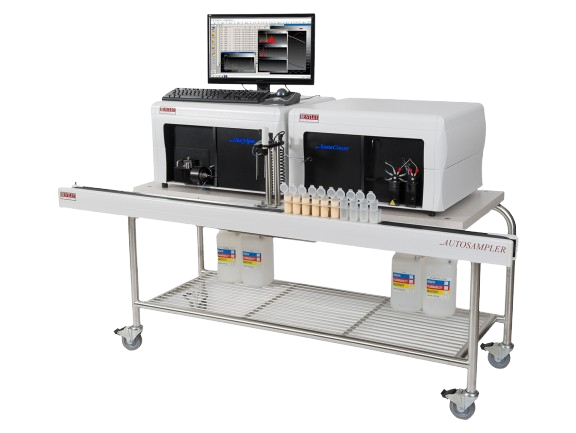
The DairySpec Combi puts a DairySpec FT module and a SomaCount FC module in one housing: the sample is drawn once and split between them, so composition and SCC both come off a single bottle. That removes the most tedious step in a dairy lab — splitting samples, labelling two sets, and queueing at a second instrument — which also happens to be where samples most easily get swapped.
Manual versus conveyor: what actually differs
The thing to be clear about first: both use the same measuring principle and deliver the same accuracy. What differs is how the sample gets into the instrument — not the quality of the answer.
| Aspect | Manual / semi-automatic | Conveyor autosampler |
|---|---|---|
| Sample presentation | Operator presents each vial to the probe | Racks go on the belt; the machine feeds and draws |
| Throughput | Under a minute per sample, paced by the operator | 100 / 150 / 200 / 250 / 300 samples per hour |
| Operator time | Someone must stand and feed it throughout | Load racks, walk away, do other work |
| Sample identification | Operator tracks the order and keys the ID | Vial IDs read automatically in belt order |
| Risk of mix-ups | Rises with volume and operator fatigue | Low — the order is locked when the rack is loaded |
| Suits | Large farms, small processors, occasional testing, research | Milk intake centres, co-ops, central labs, DHI programmes |
So which one
Two things decide it: samples per day, and how many people you have. A few dozen bottles a day and the manual unit clearly wins — same accuracy, much lower cost. Hundreds a day that must be finished within one shift, and the conveyor pays back twice over: once in the operator who no longer stands there all day, and once in the mix-ups that stop happening. In milk payment, one mix-up means paying a farmer the wrong amount.
Do not skip over sample preparation
Whichever you choose, accuracy depends on sample preparation as much as on the instrument. Milk left standing separates, with fat rising to the top; draw from that and the fat figure is wrong immediately. Samples must be brought to temperature and mixed consistently before every measurement. Conveyor-fed lines therefore usually run a preparation unit such as the Agiflex alongside, so every bottle gets the same agitation rather than however hard a particular person happened to shake it.
Which products it can handle
- Raw milk from cows, goats, sheep, and buffalo — the core job, covering intake, grading, and herd monitoring
- Cream and whey — composition checks during and after separation, to control yield and line quality
- Colostrum — quality checks before it is fed to calves, which bears directly on survival rates
- Permeate and retentate — verifying that a membrane filtration line is separating as intended
- Yoghurt and ice cream — composition of finished product, to confirm the recipe and the nutrition label
Each matrix needs its own calibration
This one is often misunderstood. An FTIR instrument does not read values straight off the spectrum; it applies a statistical model built from samples whose true values are already known. A model built on cow milk will not carry over to whey or ice cream — the matrices are too different. If you intend to extend into a new product group, settle the calibration for that group when you specify the instrument, not afterwards.
Choosing, in short
- Intake centres and co-ops issuing large daily result sets — DairySpec Combi with the conveyor, sized to the real per-shift volume
- Large farms or processors testing a few dozen a day — the manual unit gives the same accuracy on a much smaller budget
- Work that needs composition but not SCC — DairySpec FT alone is enough, with SomaCount added later
- Hygiene and contamination work at intake — consider BactoCount for bacteria counts alongside
If it is not yet clear where to start, only a few figures are needed for the conversation: samples per day, the window results must land in, the product groups to be measured, and the standard your reports have to cite. The PMC team can build the specification from there.