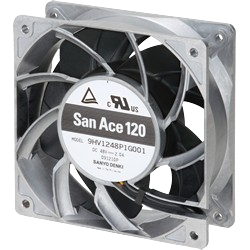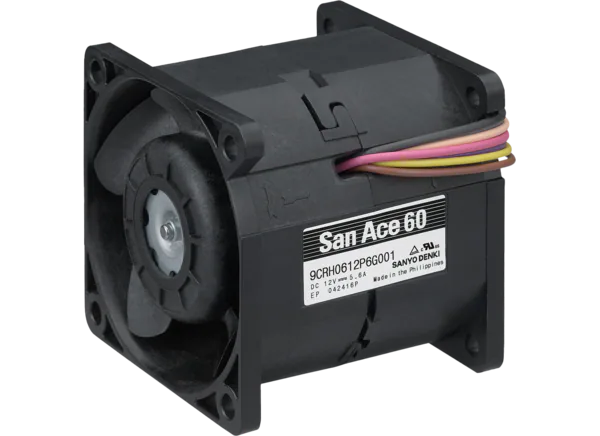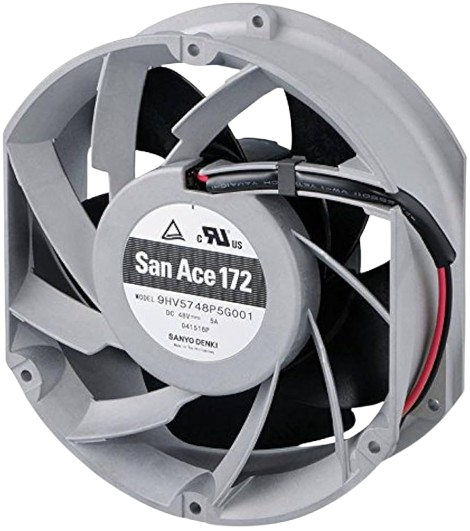
In a cooling system the fan is often overlooked — yet it is one of the parts most likely to fail, precisely because it is one of the few moving components. When a fan stops, the whole system risks heat damage. In environments with strong vibration and shock, an ordinary fan fails even faster. That is why Sanyo Denki offers San Ace models engineered specifically to withstand vibration and high G-forces.
Why ordinary fans fail where there is vibration
A fan’s weak points under sustained vibration are its bearings, its impeller/motor, and its internal circuitry. Prolonged vibration wears and fatigues these parts until they fail — so the fan lives a shorter life than it should, grows noisier over time, and can stop without warning.
- Bearings — they bear the most load; vibration wears them quickly and shortens their life dramatically.
- Impeller and motor — they wobble out of balance, creating noise and wear.
- Internal circuitry and joints — solder points and lead wires fatigue from vibration until they crack.
How vibration-resistant models solve this
Vibration-resistant San Ace fans are re-engineered specifically for vibration and shock — from the bearings and motor mounting to impeller balancing — and, crucially, they state their tolerance values clearly on the datasheet.
- High-quality dual ball bearings — better at handling both radial and axial loads.
- A more rigid motor mounting — to reduce impeller wobble.
- Precise impeller balancing — to reduce the fan’s own self-generated vibration.
- Stated vibration resistance (in G) and shock resistance (in m/s²) on the datasheet.
The two numbers to check on the datasheet
Do not pick a fan on size or airflow (CFM) alone. For vibrating applications, the heart of the decision is these two figures — they tell you directly how much the fan can take, and they must match your real operating conditions.
| Datasheet spec | What it means |
|---|---|
| Vibration resistance (G) | How many G of continuous vibration it tolerates over a stated frequency range (for vibration that is always present). |
| Shock resistance (m/s²) | How strong a momentary impact it survives (for sudden shocks — hitting a pothole, a jolt). |
Applications that truly need a vibration-resistant model
The common thread is equipment installed where vibration or shock is continuous. With an ordinary fan you end up replacing it so often that it becomes a maintenance cost and a downtime risk.
| Application group | Examples |
|---|---|
| Vehicles / transport | Cars, trucks, trains, EVs, on-vehicle equipment |
| Industrial machinery | CNC machines, motors, presses, vibrating production lines |
| Heavy / construction equipment | Excavators, loaders, cranes, drilling rigs |
| Marine | Onboard control cabinets shaken by engines and waves |
| Outdoor / field installations | Outdoor enclosures, base stations, inverter / solar cabinets |
| Moving systems / aerospace | Drones and equipment subject to G-forces while moving or accelerating |
When you do not need one
If the fan sits somewhere stable with little vibration — a server room on solid flooring, a typical PC, or an in-building control cabinet with no nearby vibration source — a standard model is enough. Put the budget toward features that matter more there, such as service life or noise level.
In short: choose a vibration-resistant San Ace fan when the equipment is installed where vibration or shock is continuous — to extend life, cut maintenance cost, and prevent mid-operation downtime. As the San Ace distributor in Thailand, the PMC Technology team can compare specs and recommend the model that fits your conditions.