Choosing a UPS for a server room usually comes down to two questions: how many kVA, and how many minutes of runtime. Both matter, but neither is what drives the long-run cost. That is decided by conversion efficiency and battery life — the two things that follow you for the entire decade the unit sits in the rack.
Why a UPS costs you twice for the same watt
An online UPS converts power continuously, and every conversion loses some. What is lost does not simply vanish — it leaves as heat, in the same room as the servers, so the cooling plant has to work harder to carry it back out. You pay once for the loss and again for removing it.
That is why a two- or three-point difference on a datasheet turns into far more money than it looks like, once you multiply it by running around the clock for ten years.
Hybrid topology: the clearest difference
Most UPS units on critical loads are online double-conversion: incoming power is rectified to DC and a fresh AC waveform is built from scratch, so the load never sees the utility directly. You get the cleanest possible power, and you pay conversion losses continuously — including on the many days when the incoming supply was perfectly fine.
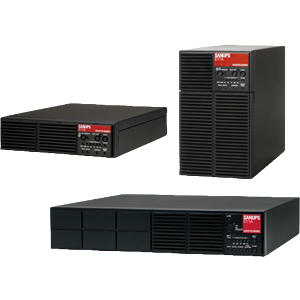
The SANUPS E11A and E11B families use a hybrid architecture with three modes, and **the unit selects the mode itself** according to the incoming supply and the load at that moment. Crucially, switching between modes causes no break in the output, so the load never notices.
| Mode | When it runs |
|---|---|
| Quality Priority | Unstable input or a sensitive load — runs full double-conversion |
| Efficiency Priority | Input is within spec — drops unnecessary conversion to push efficiency up |
| Active Filter | Corrects harmonics and compensates power factor on the incoming side |
In numbers: the hybrid reaches 95 percent efficiency, while Sanyo Denki’s own online double-conversion A11J sits at 93 percent — a figure the company already describes as industry-leading. For the E11A, Sanyo Denki quotes energy savings of up to 47 percent against running full double-conversion continuously.
The benefit that is not on the datasheet
Lower losses mean less heat in the rack, which means the internal fans work less, the batteries sit at a lower ambient temperature, and their life stretches accordingly — heat being the main enemy of any battery. Efficiency does not only save electricity; it pushes the replacement cycle further out.
Lithium-ion: ten years without a swap
In a live rack, replacing batteries is not just the price of the cells. It is a job that needs either planned downtime or a willingness to work on energised equipment, plus labour and disposal. Lead-acid strings in this duty typically hit replacement several times over before the UPS itself is worn out.
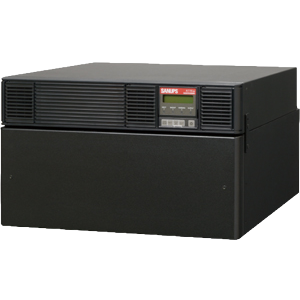
Sanyo Denki offers three lithium-ion models — A11K-Li, E11B-Li, and A11N-Li. The company states battery life is roughly twice that of the equivalent lead-acid model and that the units run for ten years with no battery replacement, and describes itself as the first in the industry to use lithium-ion in UPS of comparable specification.
Another point that separates them from most manufacturers: Sanyo Denki makes the batteries in-house rather than buying cells and assembling them. That affects both quality control and long-term supply security for spares — the latter mattering more than it first appears for equipment meant to last a decade.
A11N-Li: the one built for the rack
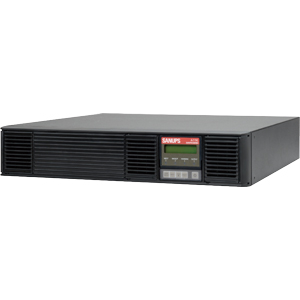
If the brief is genuinely a data centre, the closest fit is the A11N-Li: online double-conversion on lithium-ion, rated 5 kVA and 10 kVA at 200 V, in a chassis just 3U high that drops into a standard EIA/JIS 19-inch rack. Up to four units run in parallel for a combined 20 kVA.
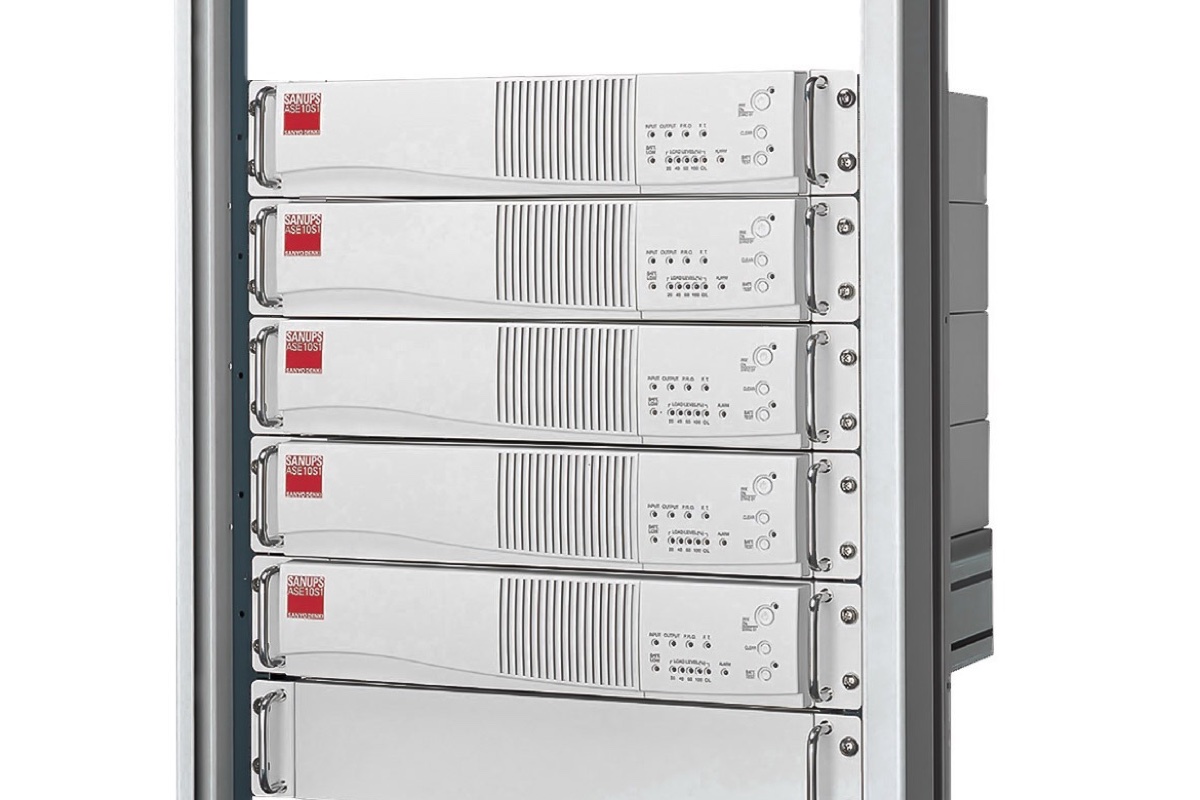
Parallel capability earns its keep twice over. First, you can start small and add capacity as the load grows instead of buying for a future you have to guess at. Second, it gives you N+1 redundancy — one unit can fail or be pulled for service and the system keeps delivering.
Matching the model to the job
| Model | Topology | Capacity | Suits |
|---|---|---|---|
| A11N-Li | Online double-conversion + lithium-ion | 5 / 10 kVA at 200 V, parallel to 20 kVA | Data centres and server rooms wanting density and no battery work for a decade |
| E11A / E11B | Hybrid, three automatic modes | 1–3 kVA, rack form | Racks with moderate loads where efficiency is the priority |
| A11J | Online double-conversion | 93 percent efficiency | Loads that want uncompromised clean power at all times |
| A11K-Li | Online double-conversion + lithium-ion | 1000 / 1500 VA, −20 to +55 °C | Comms cabinets and unattended sites outside a cooled room |
What to actually compare against other brands
- Efficiency in the mode you will actually run, not the headline number. Ask whether that mode lets the load see utility power, and under what conditions it was measured.
- Battery life and replacement cycle, counted as how many times someone must work inside the rack across ten years — not the price per cell.
- Rack units consumed per kVA, because space in the rack has its own cost.
- Whether units can be paralleled, and how far N+1 can be taken.
- Who makes the batteries, and for how many more years spares will be available.
Worth checking before you order
- The efficiency and capacity figures here are Sanyo Denki’s own published values. Ask for the datasheet of the exact model and part number you intend to order.
- Several models are built around Japanese 100 V or 200 V supplies. Confirm the variant you will receive matches the voltage and frequency on site in Thailand.
- Lithium-ion carries different shipping and disposal requirements from lead-acid. Settle that during project planning, not at delivery.
If you are comparing rack UPS options, only a few figures are needed to start: the real load in kW, the runtime you need, how many rack units are free, and the supply arrangement on site. The PMC team can build the specification and the comparison from there.