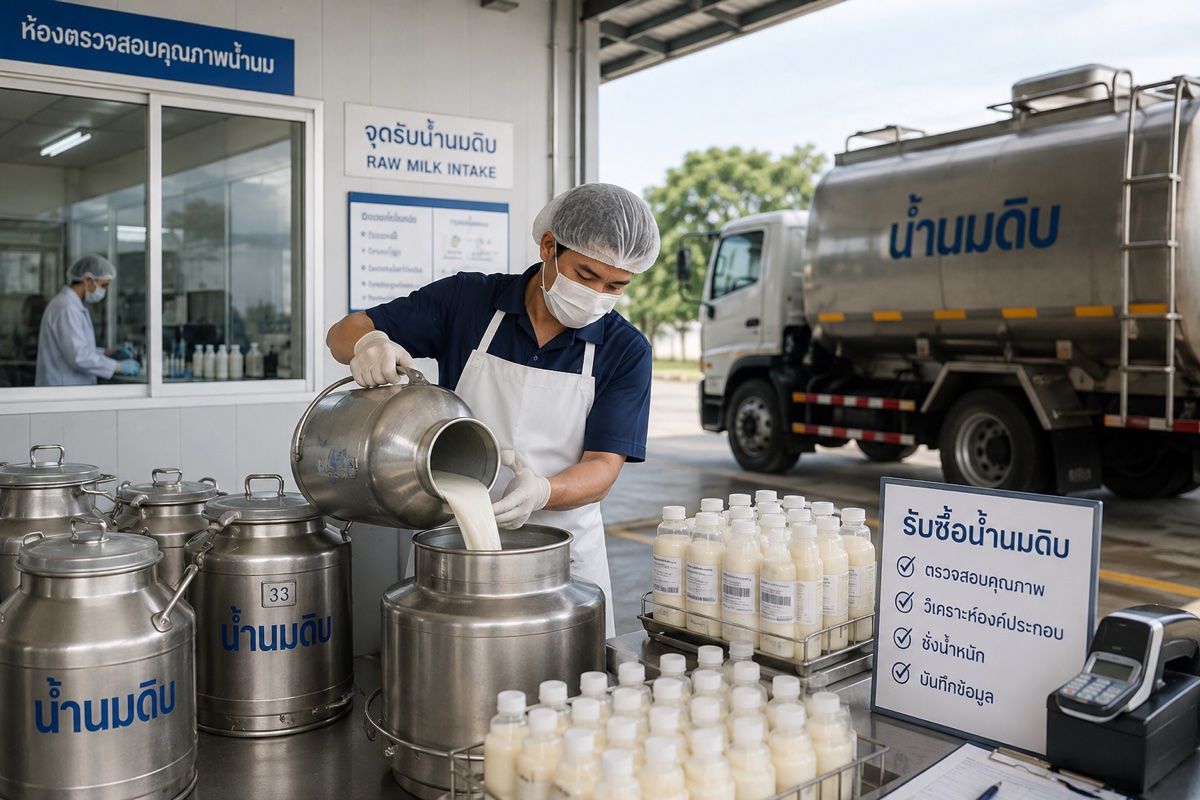
When someone says milk is "good quality", that is never a single number. It is a set of them, each answering a different question: some decide what the farmer gets paid, some say whether the cow is sick, some reveal that the milk was watered down or mishandled on the way in. Skip one and it usually resurfaces later — in processing, or after the product has reached a consumer.
1. Fat and protein — what sets the price
These two are the core of milk payment, because they are what actually becomes product: protein drives cheese and powder yield, fat drives cream and butter. Most payment schemes therefore pay on kilograms of fat and protein rather than on volume alone — so even a small measurement error moves money on both sides straight away.
2. Total solids and solids-not-fat — processing yield
Total solids and solids-not-fat say how much real substance a kilogram of milk holds once the water is taken out. Powder and condensed-milk plants use them to work out yield and the energy cost of evaporation. When they read low while fat and protein look normal, that usually points at added water — which item 5 then confirms.
3. Somatic cell count — udder health across the herd
Somatic cells are body cells shed into milk, mostly white blood cells sent to fight infection in the udder, which makes the count the standard indicator of mastitis worldwide. It is not only an animal-health matter: high-SCC milk carries more protein-degrading enzymes, which cuts cheese yield and shortens shelf life.
The figures most often quoted: the EU sets a three-month rolling geometric mean of no more than 400,000 cells per millilitre, while the US Grade A limit for cow milk is 750,000. Buyers in Thailand generally set their own thresholds and price tiers, so the contract with your buyer is what actually governs.
4. Bacteria count — hygiene and the cold chain
Bacteria count reports two things at once: how clean the milking and the equipment were, and how well temperature was held in storage and transport. Milk harvested cleanly but left warm for a few hours will still spike. The commonly cited ceiling is 100,000 CFU per millilitre, in both the EU rules and the US Grade A standard.
5. Added water — read from the freezing point
Real milk freezes below pure water because of what is dissolved in it, and that point is remarkably consistent in normal milk. Add water and the freezing point moves towards zero immediately. Freezing point depression is therefore the most direct test for watering-down, and one buyers can reject a load on.
6. Urea (MUN) — a read-out of the ration
Milk urea reflects the balance between protein and energy in what the herd is being fed. Too high usually means protein is being over-supplied — wasted feed cost and a nitrogen load on the animal. Too low means protein is short and yield will follow it down. This is a number for running the farm rather than for pricing the load.
7. Acidity and pH — freshness
As bacteria start working on lactose, lactic acid rises and pH falls, which makes this an early warning that milk is going off — before anyone can see or smell it. It matters most at intake, because milk that has already turned acidic will curdle when it meets heat during pasteurisation.
8. Free fatty acids — the rancid note
When the membrane around the fat globules is damaged, fat breaks down into free fatty acids, which taste and smell rancid. The usual causes are pumping that is too aggressive, air drawn into the line, or simply agitating the milk more than necessary. This is the number that catches mechanical problems in the milking and transport system that nothing else reveals.
9. Antibiotic residues — the one you cannot miss
Milk from a cow recently treated with antibiotics must be held back until the withdrawal period has passed. This is consumer safety first, but it is also technical: antibiotics kill the starter cultures used for yoghurt and cheese, ruining a whole vat. One contaminated churn can get an entire tanker rejected.
This one needs a separate test kit
The analysers discussed here cannot detect antibiotics — it is a different principle entirely, and needs a dedicated rapid test at intake. Do not design a testing regime assuming a composition analyser covers this one.
The nine at a glance
| What you test | The question it answers | Measured by |
|---|---|---|
| Fat, protein | What to pay | FTIR |
| TS / SNF | Processing yield | FTIR |
| Somatic cell count | Is the herd sick | Flow cytometry |
| Bacteria count | Clean and cold enough | Flow cytometry |
| Freezing point | Was water added | FTIR |
| Urea (MUN) | Is the ration balanced | FTIR |
| Acidity / pH | Still fresh | FTIR |
| Free fatty acids | Is the system bruising the milk | FTIR |
| Antibiotic residues | Safe to drink | Separate test kit |
That table is the reason a dairy lab does not need nine instruments. Eight of the nine come from two principles, and one manufacturer builds both into the same platform.
Bentley Instruments: eight of the nine from one sample
Bentley Instruments is a Belgian company that has built milk analysers since 1982, and makes both the FTIR and the flow-cytometry side itself — so the range covers almost the whole checklist without the sample having to travel between brands.
| Model | Covers items | What it does |
|---|---|---|
| DairySpec FT | 1, 2, 5, 6, 7, 8 | FTIR composition analyser reading up to 64 parameters from a single shot — fat, protein, lactose, solids, urea, freezing point, casein, free fatty acids, and the fatty-acid profile. Reagent-free, so cost per test stays low. |
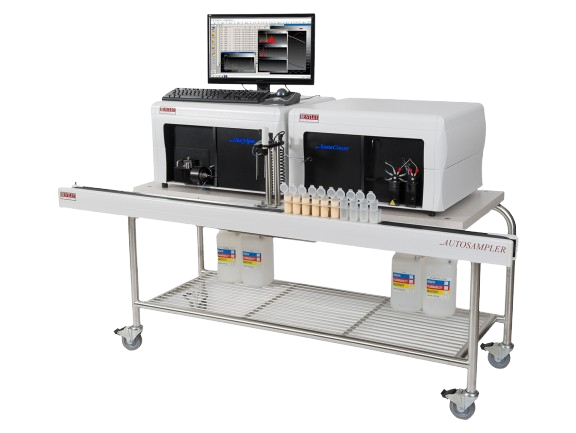
| SomaCount FC | 3 | Flow-cytometry somatic cell counter covering 0 to 10 million cells per millilitre, compliant with ISO 13366, in manual and conveyor versions from 100 to 300 samples per hour. |
| DairySpec Combi | 1, 2, 3, 5, 6, 7, 8 | Puts the DairySpec FT and SomaCount FC modules in one housing: the sample is drawn once and yields both composition and somatic cells, removing the split-and-relabel step where samples most often get swapped. |
| BactoCount IBC | 4 | Flow-cytometry counter that enumerates individual bacteria in about two minutes, against the overnight wait of a plate count — so the accept-or-reject decision can be made while the tanker is still on the weighbridge. |
Why one platform matters
- One sample, no splitting, no second set of labels, no queue at another instrument — the three places where dairy labs most often mix samples up.
- Every value lands in one report at the same time. When you have to explain a price to a farmer, all the numbers came from the same bottle at the same moment.
- Cost per sample stays low because the FTIR side uses no reagents at all; only the cell-counting side needs buffer and stain.
- It scales with the workload: start manual, move to a conveyor at 100 to 300 samples per hour as volume grows, without changing system or method.
- It stands on international references — ISO 9622 for the FTIR side and ISO 13366 for somatic cells — which you need when results are the basis for paying or rejecting a load.
If you are putting a milk-quality regime together — intake centre, co-op, processor, or a large farm — the figures to bring are: samples per day, the window results must land in, the parameters your buyer contract specifies, and any dairy products beyond raw milk you need to measure. The PMC team can build the specification from that.