Modern manufacturing — assembling chips, aligning optics, building medical devices, testing circuit boards — all depends on motion that returns to exactly the same point every time, down to the micron (one micron = one-thousandth of a millimetre). The component that makes that possible is the linear motor: a motor that drives straight-line motion directly. It is steadily replacing older transmission systems wherever precision is the priority.
What is a linear motor — and what does “direct drive” mean?
Picture an ordinary rotary motor “unrolled” into a straight line: instead of spinning a shaft, its magnetic force pushes a carriage directly along a rail. That is a direct-drive linear motor — the driving force reaches the load directly, with no intermediate mechanism converting rotation into linear travel, such as a ballscrew, belt, or rack-and-pinion.
Why direct drive beats screws and belts
Every intermediate part in the power path erodes precision. Ballscrews and belts have backlash (mechanical play), flex slightly under load (compliance), wear over time, and need lubrication — all of which make the real position drift from the commanded one, and worsen as the system ages. Removing those parts is exactly why direct drive is both more precise and more stable over its life.
- Backlash — mechanical play in gears/screws that shifts the position when reversing direction.
- Compliance — belts or screws stretch slightly under load.
- Wear — contacting parts degrade, so precision drops over time.
- Lubrication — requires maintenance and risks contamination in clean processes.
The word “precision” actually hides three different numbers
People often describe a system as “precise” with a single figure, but in automation there are three distinct numbers, and you need all three. Understanding them is the key to choosing the right hardware — without overpaying, and without missing the spec your process actually needs.
- Resolution — the smallest step the system can command and measure, e.g. 100 nanometres.
- Accuracy — how close the real position lands to the commanded position.
- Repeatability — how tightly it returns to the same point when commanded again and again.
In automation that repeats the same move tens of thousands of times a day — placing a part on the same spot — repeatability is usually the figure that matters most. Jenny Science’s LINAX linear motors achieve repeatability down to ±0.4–0.5 microns (around 100–150× thinner than a human hair), with an optional resolution as fine as 100 nanometres.
What determines a linear motor’s precision
- The position measuring system (encoder) — an optical glass scale resolves down to 100 nanometres.
- Stiffness — a more rigid structure holds position better under load.
- Settling time — how quickly it stabilises after a move before the next step.
- Temperature — thermal expansion shifts position, so good thermal design matters.
LINAX uses an integrated optical glass scale to measure position directly, with an optional absolute measuring system that knows its position the instant it powers on — no homing run required — for faster, safer start-ups.
Meet the Jenny Science LINAX family — and choose the right one
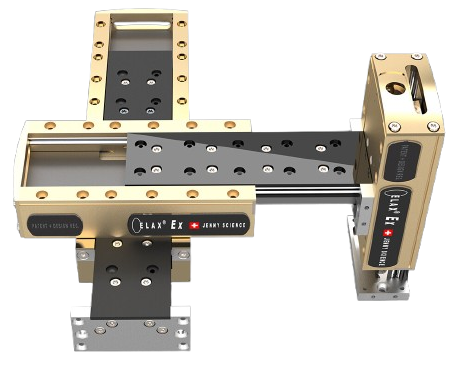
Jenny Science is a Swiss maker of high-precision linear motors. The LINAX family comprises direct-drive linear axes spanning strokes from 44 to 2000 mm, forces from 8 to 300 N, and speeds up to 4 m/s — offered in four main types to match different jobs.
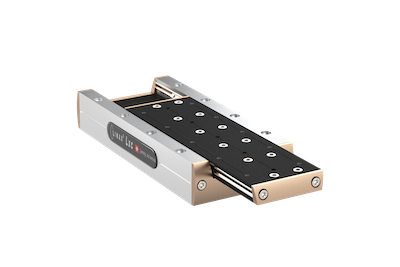
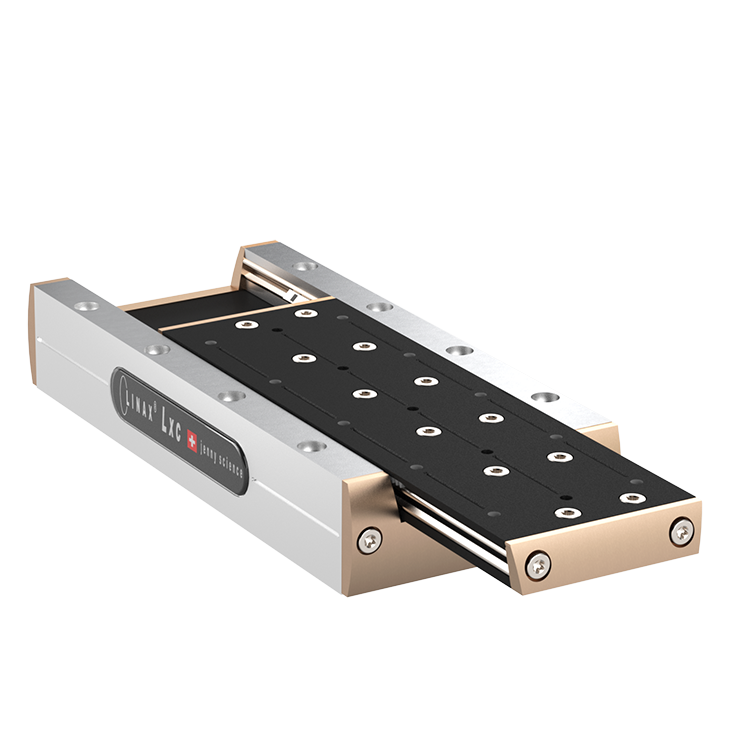
- Lxc (compact) — patented monoblock design, compact, stroke 44–272 mm, force 8–40 N, repeatability ±0.5 µm (optional 100 nm resolution). Ideal where space is tight.
- Lxu (universal) — single-cable with an absolute measuring system (no homing), nominal force 60 N, stroke 40–320 mm. A flexible all-rounder.
- Lxe (exclusive) — a flat, easy-to-clean cover, stroke 250–1000 mm. Suited to hygiene-focused jobs and longer travel.
- Lxs F120 (shuttle) — a low 45 mm profile, high force (nominal 120 N / peak 300 N), stroke up to 2000 mm. Built for heavier loads and long travel.
Direct drive = clean and virtually maintenance-free
With no screw or belt to lubricate, a linear motor sheds very few particles — ideal for cleanrooms, medical, and semiconductor work. It also has few wearing parts, so it is easy to maintain and long-lived. The Lxc monoblock design goes further: only the magnets and glass scale move while the coils stay fixed in the structure, cutting moving cables and wear even more.
Where this level of precision pays off
- Semiconductor handling and placement.
- Medical device assembly and micro-assembly.
- Aligning lenses and fibre (optics and photonics).
- Electronics assembly and test.
- Lab automation and precision dispensing.
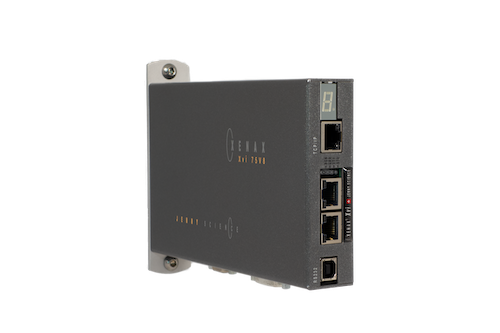
LINAX linear motors pair with Jenny Science’s XENAX servo controllers and can add Forceteq force-measurement technology for press-and-assemble tasks that need controlled force. As the distributor in Thailand, the PMC Technology team can analyse your application and recommend the model that fits your precision, travel, and force requirements.